 wikimagazines@gmail.com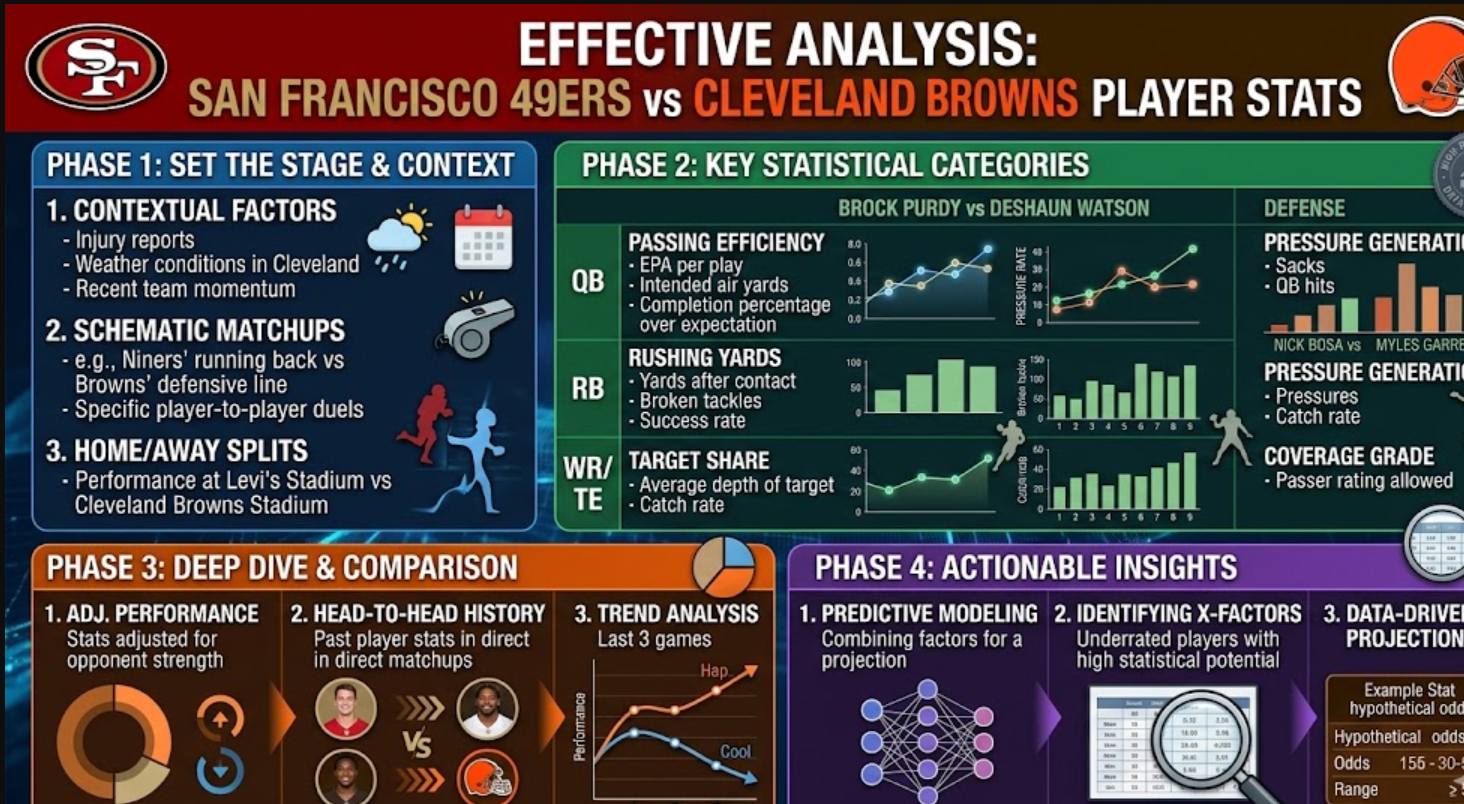
Player stats are the backbone of understanding any NFL game, including the 49ers vs Cleveland Browns match player stats. They provide a detailed picture of individual and team performance that goes far beyond the final score. From tracking a quarterback’s passing efficiency to monitoring a linebacker’s tackle count, stats reveal who is making key contributions, where a team’s strengths and weaknesses lie, and how strategies unfold on the field. For fans, analysts, and fantasy football players alike, these numbers offer actionable insights, helping predict future performance, evaluate coaching decisions, and appreciate the nuances of the game that casual observation alone can miss.
Understanding Key Offensive Metrics
Offensive metrics are essential when analyzing the 49ers vs Cleveland Browns match player stats because they reveal how effectively a team moves the ball and scores points. Key statistics like passing yards, completion percentage, rushing yards, and touchdowns provide a clear picture of which players are driving the offense. For instance, a quarterback with a high completion rate combined with significant passing yards indicates both accuracy and productivity, while a running back with strong yards-per-carry and yards-after-contact numbers demonstrates the effectiveness of the ground game and offensive line. These stats help fans and analysts identify game-changing players and understand how different offensive strategies succeed or struggle during the matchup.
Beyond the basics, situational metrics like third-down conversions and red-zone efficiency offer deeper insights. A team that excels on third downs shows resilience in sustaining drives, while red-zone efficiency highlights which players capitalize on scoring opportunities. By combining these metrics, analysts can not only determine who performed well but also why certain plays succeeded or failed. Understanding offensive stats in context allows for a more nuanced view of the game, making it easier to predict outcomes, evaluate coaching decisions, and appreciate the tactical depth of an NFL matchup.
Defensive Performance Analysis
Defense plays a pivotal role in shaping the outcome of any NFL game, and analyzing the 49ers vs Cleveland Browns match player stats from a defensive perspective reveals which players and strategies effectively disrupt the opposing offense. Key metrics include tackles, sacks, interceptions, forced fumbles, and passes defended, each offering insight into how a defense limits scoring opportunities and creates turnovers. For example, a defensive end with multiple sacks not only pressures the quarterback but can change the rhythm of the entire game, while a linebacker with high tackle numbers demonstrates consistency in stopping both run and pass plays. Understanding these stats in context helps fans and analysts recognize defensive strengths, expose weaknesses, and evaluate the impact of individual players, making defense just as critical as offense in predicting the flow and outcome of a matchup.
Special teams are often overlooked but can be a game-changer in any NFL matchup, and analyzing the 49ers vs Cleveland Browns match player stats highlights their critical role. Key metrics include kickoff and punt return yards, field goal accuracy, punt and kickoff coverage, and blocked kicks. A single long return or a successful onside kick can dramatically shift momentum, while missed field goals or poor coverage can lead to easy scoring opportunities for the opponent. By evaluating these stats, analysts can identify which special teams players are making significant contributions and how their performance directly influences field position, scoring chances, and ultimately, the game’s outcome.
Player Comparisons: Stars vs Role Players
In any NFL game, including the 49ers vs Cleveland Browns match player stats, it’s crucial to distinguish between the impact of star players and role players. Star athletes often dominate the headlines with high passing yards, rushing touchdowns, or spectacular defensive plays, but role players provide the consistency and support that allow stars to shine. For example, a wide receiver may not lead the team in touchdowns but consistently creates separation and reliable catches, enabling the quarterback to execute key plays. Similarly, offensive linemen may not appear in standard box scores, yet their blocking directly affects both rushing and passing success. Comparing stats between stars and role players provides a more complete understanding of team dynamics, showing how individual performances contribute to overall strategy, drive efficiency, and ultimately influence the outcome of the game.
Using Advanced Analytics for Deeper Insights
While traditional statistics like yards, touchdowns, and tackles provide a solid overview, advanced analytics offer a deeper understanding of the 49ers vs Cleveland Browns match player stats. Metrics such as DVOA (Defense-adjusted Value Over Average), EPA (Expected Points Added), and win probability models quantify player contributions in ways that traditional stats cannot. For example, a running back who gains fewer yards on paper may have a high EPA if those yards come in critical situations, such as third-and-short or red-zone plays, demonstrating clutch performance that can swing the game. Similarly, defensive players may not accumulate flashy statistics but could significantly reduce opponent efficiency, as reflected in advanced defensive metrics. These analytics allow analysts, coaches, and fans to evaluate player impact more accurately, going beyond surface-level numbers to measure actual influence on game outcomes.
Advanced analytics also enable predictive insights, which are invaluable for understanding trends and planning strategies. By analyzing situational data—like performance under pressure, success rates in different formations, or efficiency against specific types of plays—teams can tailor their approach to maximize strengths and exploit opponent weaknesses. For instance, the 49ers vs Browns match could be dissected to see which quarterback performs better under blitz pressure or which wide receiver excels in contested catches. Using these metrics, analysts can create a more nuanced and strategic picture of player performance, making advanced statistics an essential tool for modern NFL analysis.
Historical Matchup Trends Between 49ers and Browns
Examining historical matchup trends provides valuable context when analyzing 49ers vs Cleveland Browns match player stats, as past encounters often reveal patterns that can influence future games. For instance, reviewing head-to-head statistics such as average points scored, rushing and passing yardage, turnovers, and defensive stops helps identify which team typically gains an advantage in specific areas. Certain players may consistently perform well against the opposing team due to favorable matchups, while others may struggle under pressure. Additionally, understanding trends like home-field advantage, performance in close games, or scoring tendencies in the first versus second half offers insights into strategies and adjustments that coaches might employ. By considering historical data alongside current-season stats, analysts and fans can create a more complete picture of how the 49ers and Browns are likely to perform, adding depth to predictions and game analysis.
How Coaching Strategies Influence Player Stats
Coaching strategies play a crucial role in shaping the 49ers vs Cleveland Browns match player stats, as the way a team is coached often determines how players perform on the field. Game plans dictate which players are targeted, how plays are executed, and how risks are managed in different situations. For example, a coach may design a heavy running-game approach to exploit a weak defensive line, which can boost rushing yards for running backs while limiting passing opportunities for quarterbacks. Similarly, defensive schemes such as zone coverage or blitz packages directly impact metrics like sacks, tackles, and interceptions. By analyzing stats in conjunction with coaching tendencies, fans and analysts can better understand why certain players excel in specific matchups and how strategic decisions affect individual performance.
Beyond in-game strategies, coaching also influences player development and consistency over the season. Playcalling, rotation patterns, and situational decision-making can elevate role players to key contributors or maximize the strengths of star athletes. For instance, a wide receiver may see increased targets on third downs if the coach identifies favorable matchups, while a cornerback might rack up pass deflections due to a scheme emphasizing press coverage. By connecting coaching choices with player statistics, analysts gain a deeper understanding of how tactical decisions translate into measurable outcomes, revealing the intricate interplay between strategy, skill, and performance in any NFL game.
Conclusion and Key Takeaways
Analyzing 49ers vs Cleveland Browns match player stats offers a comprehensive understanding of how each team performs, both individually and collectively, beyond just the final score. By examining offensive and defensive metrics, special teams contributions, player comparisons, advanced analytics, historical trends, and coaching strategies, fans and analysts can gain valuable insights into the factors that influence game outcomes. Player stats reveal not only who made the big plays but also why certain strategies worked or failed, highlighting the intricate balance between talent, teamwork, and tactical decisions. Whether you are evaluating star performers, role players, or the effectiveness of coaching schemes, a detailed statistical approach ensures a deeper appreciation of the game and equips you with the knowledge to predict and analyze future matchups with confidence.
FAQs
1. What are the most important stats to track in a 49ers vs Cleveland Browns matchup?
Key stats include passing yards, rushing yards, touchdowns, tackles, sacks, interceptions, third-down conversions, and red-zone efficiency. These metrics provide a clear picture of both individual and team performance.
2. How do advanced analytics enhance understanding of player stats?
Advanced metrics like DVOA (Defense-adjusted Value Over Average) and EPA (Expected Points Added) measure player contributions in context, highlighting efficiency, situational impact, and overall influence on the game beyond traditional stats.
3. Why is analyzing historical matchups between teams important?
Historical trends reveal patterns in scoring, player performance, and strategic tendencies, helping predict outcomes and understand how specific matchups may favor one team over another.
4. How do coaching strategies affect player stats?
Coaches influence stats through playcalling, rotations, and schemes. For example, a run-heavy game plan can boost rushing stats, while defensive schemes like blitzes or zone coverage can affect tackles, sacks, and interceptions.
More Information Go And Visit:- Wiki Magazines